
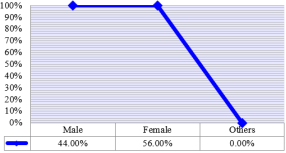
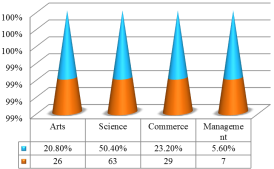
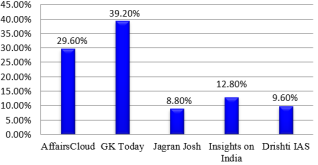
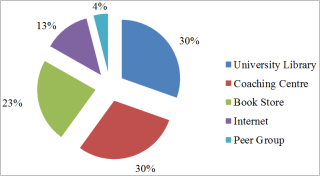
This study examines the access and utilization of information resources and digital tools by students preparing for competitive examinations at Mangalore University Library. Using questionnaires, informal interviews, and observations, data were collected from 125 respondents preparing for exams such as UPSC, KPSC, NET/SET, KSP, IBPS, KEA, SSC, and various banking tests. The findings reveal a growing reliance on digital platforms such as Unacademy, BYJU’S, Testbook, and Oliveboard for courses and mock tests, despite limited awareness and training in using these resources effectively. While most still prefer printed materials, there is a noticeable shift toward online platforms, particularly for mock testing and current affairs preparation. The majority of respondents were female (56%) and postgraduate students (51.2%), with Science students forming the largest disciplinary group (50.4%). GK Today and Affairs Cloud emerged as the most preferred online sources, whereas the university library and coaching centers were the leading physical resources for preparation. Books remain the dominant learning medium (37.5%), followed by electronic resources (24.17%). The study highlights the need for improved digital infrastructure, dedicated library sections for competitive exam preparation, and user orientation programs to enhance awareness and effective use of available resources. It emphasizes the necessity for academic libraries to adapt to evolving student needs by integrating print and digital support systems for competitive exam aspirants.
| Published in | American Journal of Information Science and Technology (Volume 10, Issue 1) |
| DOI | 10.11648/j.ajist.20261001.11 |
| Page(s) | 1-7 |
| Creative Commons |
This is an Open Access article, distributed under the terms of the Creative Commons Attribution 4.0 International License (http://creativecommons.org/licenses/by/4.0/), which permits unrestricted use, distribution and reproduction in any medium or format, provided the original work is properly cited. |
| Copyright |
Copyright © The Author(s), 2026. Published by Science Publishing Group |
Competitive Exam Aspirants, Academic Libraries, Digital Resources, Information Access, E-Resources, Digital Learning Tools, Study Materials, Library Services
Time Utilized per Day | Frequency of Respondents | Percentage (%) |
|---|---|---|
Up to 1 hour | 28 | 22.40% |
1 to 2 hours | 15 | 12.00% |
2 to 3 hours | 39 | 31.20% |
3 to 4 hours | 14 | 11.20% |
More than 4 hours | 29 | 23.20% |
Total | 125 | 100.00% |
User Category | Frequency of Respondents | Percentage (%) |
|---|---|---|
UG Students | 29 | 23.20% |
PG Students | 64 | 51.20% |
Research Scholars | 28 | 22.40% |
Others | 4 | 3.20% |
Total | 125 | 100.00% |
Website | No. of Respondents | Percentage (%) |
|---|---|---|
www.testbook.com | 32 | 25.60% |
www.adda247.com | 23 | 18.40% |
www.unacademy.com | 31 | 24.80% |
www.byjus.com | 12 | 9.60% |
www.oliveboard.in | 17 | 13.60% |
www.studyiq.com | 10 | 8.00% |
Total | 125 | 100.00% |
Category | Exam Type | No. of Respondents | Percentage (%) |
|---|---|---|---|
Civil Services Exams | UPSC (IAS, IPS, IFS, etc.) | 7 | 5.60% |
KPSC (Group A, B, C, D posts) | 26 | 20.80% | |
PDO (Panchayat Development Officer) | 4 | 3.20% | |
VAO (Village Administrative Officer) | 3 | 2.40% | |
Teaching & Research | NET/JRF, SLET | 35 | 28.00% |
TET/CTET (Teacher Eligibility Tests) | 8 | 6.40% | |
Primary & High School Teacher | 5 | 4.00% | |
PU Lecturer / Assistant Professor | 20 | 16.00% | |
Banking & Financial Sector | IBPS PO / Clerk | 7 | 5.60% |
RRB (Regional Rural Banks) | 0 | 0.00% | |
LIC / GIC / NIACL | 0 | 0.00% | |
SSC, Clerical Jobs, & Police | SSC CGL | 0 | 0.00% |
LDC / UDC | 0 | 0.00% | |
Railway Recruitment Board (RRB) | 3 | 2.40% | |
Police & Defence Services | KSP (Karnataka State Police) | 5 | 4.00% |
Indian Army / Navy / Air Force (NDA, CDS, etc.) | 2 | 1.60% | |
Indian Navy / Army Technical Entry | 1 | 0.80% | |
Total | 125 | 100.00% |
Resource | Frequency of Respondents | Percentage (%) |
|---|---|---|
Books | 45 | 37.50% |
E-Resources | 29 | 24.17% |
Magazines | 18 | 15.00% |
Mobile Apps | 15 | 12.50% |
Newspapers | 7 | 5.83% |
Online Mock Tests | 6 | 5.00% |
YouTube Videos | 5 | 4.17% |
Total | 120 | 100.00% |
UPSC | Union Public Service Commission |
KSP | Karnataka State Police Recruitment |
IFS | Indian Foreign Service |
IPS | Indian Police Service |
IAS | Indian Administrative Service |
NET /JRF | National Eligibility Test / Junior Research Fellowship |
SLET | State Level Eligibility Test |
TET | Teacher Eligibility Test |
CTET | Central Teacher Eligibility Test |
SSC | Staff Selection Commission |
RRB | Railway Recruitment Board |
IBPS | Institute of Banking Personnel Selection |
LIC | Life Insurance Corporation |
GIC | General Insurance Corporation |
NIACL | New India Assurance Co. Ltd. |
KPSC | Karnataka Public Service Commission |
PDO | Panchayat Development Officer |
VAO | Village Administrative Officer |
| [1] | Aboobacker, Y., & Sanjeevi, K. (2025). Library: A learning hub for competitive exam aspirants.International Journal of Creative Research Thoughts, 13(8), 504–505. |
| [2] | Samuel, A. D., &Nkechi E.E.(2016).Relationship between Information Literacy and Use of Electronic Information Resources by Postgraduate Students of the University of Ibadan. Library Philosophy and Practice (e-journal), 1-16. |
| [3] | Balakrishnan, R., & Ramalingam, J. (2019). Digital Literacy Skills of the Aspirants of Competitive Examinations in the Anna Centenary Library, Chennai: A Study. Library Philosophy and Practice (e-journal), University of Nebraska–Lincoln. 1-16. |
| [4] | Danner, R. B., & Pessu, C. O. (2013). A survey of ICT competencies among students in teacher preparation programmes at the University of Benin, Benin City, Nigeria. Journal of Information Technology Education: Research, 12, 33–49. |
| [5] |
Dhimmar, H. N., & Naik, B. J. (2024). Library and information sources and services for preparation of competitive examinations: A study with reference to public library.Indian Journal of Library Science Research & Information Technology, 1(2), [July–December Issue]. BMS Publishing House.
https://www.bmsgroup.in/product/indian-journal-of-library-science-research-information-technology/ |
| [6] | Gandhasiri, N., & Kumar, D. C. R. (2023).The role of university libraries in providing materials for competitive examinations to the users in Telangana. Anveshana’s International Journal of Research in Education, Literature, Psychology and Library Sciences, 8(3), 37–46. |
| [7] | Hadagali, G. S., &Kumbar, B. D. (2011). Use of Internet by faculty members and research scholars in the 21st century: A study of university libraries of Karnataka State, India. Sri Lankan Journal of Librarianship and Information Management, 4(1–2), 1–17. |
| [8] | R. Jeyshankar, N. Nachiappan, & Lavanya, A. (2018). Analysis of Gender Differences in Information Retrieval Skills in the Use of Electronic Resources among Post Graduate Students of Alagappa University, Tamil Nadu. 1–18. |
| [9] | Kaur, B., & Verma, R. (2009). Use of Electronic Information Resources: A Case Study of Thapar University. DESIDOC Journal of Library & Information Technology, 29(2), 67–73. |
| [10] | Pradeep Kumar, D., & Maranna, O. (2024). Access, awareness, and use of electronic information resources by science postgraduate students of Gulbarga University, Kalaburagi: A study. Library Progress (International), 44(6), 1078–1088. |
| [11] | Ramesh, A., & Kishore Kumar, S. (2016). A study on the practices and utility of resources by the aspirants of competitive exams in Karaikal District (Puducherry U.T.). Journal of Advances in Library and Information Science, 5(4), 330–336. |
| [12] | Shen, C.-H., Chou, C.-M., Hsiao, H.-C., & Lee, Y.-J. (2013). Analysis of Core Competency Required for the Managerial Work Force of Small and Medium Enterprises in Taiwan. Journal of Software Engineering and Applications, 06(03), 111–113. |
| [13] | Thanuskodi, S., &Kalyani, K. S. (2018). Utilization of information resources among the civil service exam aspirants at Chennai: A study. Library Philosophy and Practice (e-journal), 1782. University of Nebraska–Lincoln. |
| [14] | Wagay, J., & Sehgal, P. C. (2021). Use of electronic resources among Library Science students of Kashmir. Library Philosophy and Practice (e-journal), 6305. |
| [15] | Xie, X., & Lu, C. (2025). Bridging the digital gradient: How digital literacy and information perception shape innovation and entrepreneurship across urban, county, and township students.Sustainability, 17(22), 9942. |
APA Style
Ramachandragouda, S., Purushothmagowda, M., Naik, U., Renuka. (2026). Access and Usage of Information Resources and Digital Tools by Competitive Exam Aspirants in Mangalore University Library. American Journal of Information Science and Technology, 10(1), 1-7. https://doi.org/10.11648/j.ajist.20261001.11
ACS Style
Ramachandragouda, S.; Purushothmagowda, M.; Naik, U.; Renuka. Access and Usage of Information Resources and Digital Tools by Competitive Exam Aspirants in Mangalore University Library. Am. J. Inf. Sci. Technol. 2026, 10(1), 1-7. doi: 10.11648/j.ajist.20261001.11
AMA Style
Ramachandragouda S, Purushothmagowda M, Naik U, Renuka. Access and Usage of Information Resources and Digital Tools by Competitive Exam Aspirants in Mangalore University Library. Am J Inf Sci Technol. 2026;10(1):1-7. doi: 10.11648/j.ajist.20261001.11
@article{10.11648/j.ajist.20261001.11,
  author = {Shivaraja Ramachandragouda and M. Purushothmagowda and Umesha Naik and Renuka},
  title = {Access and Usage of Information Resources and Digital Tools by Competitive Exam Aspirants in Mangalore University Library},
  journal = {American Journal of Information Science and Technology},
  volume = {10},
  number = {1},
  pages = {1-7},
  doi = {10.11648/j.ajist.20261001.11},
  url = {https://doi.org/10.11648/j.ajist.20261001.11},
  eprint = {https://article.sciencepublishinggroup.com/pdf/10.11648.j.ajist.20261001.11},
  abstract = {This study examines the access and utilization of information resources and digital tools by students preparing for competitive examinations at Mangalore University Library. Using questionnaires, informal interviews, and observations, data were collected from 125 respondents preparing for exams such as UPSC, KPSC, NET/SET, KSP, IBPS, KEA, SSC, and various banking tests. The findings reveal a growing reliance on digital platforms such as Unacademy, BYJU’S, Testbook, and Oliveboard for courses and mock tests, despite limited awareness and training in using these resources effectively. While most still prefer printed materials, there is a noticeable shift toward online platforms, particularly for mock testing and current affairs preparation. The majority of respondents were female (56%) and postgraduate students (51.2%), with Science students forming the largest disciplinary group (50.4%). GK Today and Affairs Cloud emerged as the most preferred online sources, whereas the university library and coaching centers were the leading physical resources for preparation. Books remain the dominant learning medium (37.5%), followed by electronic resources (24.17%). The study highlights the need for improved digital infrastructure, dedicated library sections for competitive exam preparation, and user orientation programs to enhance awareness and effective use of available resources. It emphasizes the necessity for academic libraries to adapt to evolving student needs by integrating print and digital support systems for competitive exam aspirants.},
 year = {2026}
}
TY  - JOUR
T1  - Access and Usage of Information Resources and Digital Tools by Competitive Exam Aspirants in Mangalore University Library
AU  - Shivaraja Ramachandragouda
AU  - M. Purushothmagowda
AU  - Umesha Naik
AU  - Renuka
Y1  - 2026/01/07
PY  - 2026
N1  - https://doi.org/10.11648/j.ajist.20261001.11
DO  - 10.11648/j.ajist.20261001.11
T2  - American Journal of Information Science and Technology
JF  - American Journal of Information Science and Technology
JO  - American Journal of Information Science and Technology
SP  - 1
EP  - 7
PB  - Science Publishing Group
SN  - 2640-0588
UR  - https://doi.org/10.11648/j.ajist.20261001.11
AB  - This study examines the access and utilization of information resources and digital tools by students preparing for competitive examinations at Mangalore University Library. Using questionnaires, informal interviews, and observations, data were collected from 125 respondents preparing for exams such as UPSC, KPSC, NET/SET, KSP, IBPS, KEA, SSC, and various banking tests. The findings reveal a growing reliance on digital platforms such as Unacademy, BYJU’S, Testbook, and Oliveboard for courses and mock tests, despite limited awareness and training in using these resources effectively. While most still prefer printed materials, there is a noticeable shift toward online platforms, particularly for mock testing and current affairs preparation. The majority of respondents were female (56%) and postgraduate students (51.2%), with Science students forming the largest disciplinary group (50.4%). GK Today and Affairs Cloud emerged as the most preferred online sources, whereas the university library and coaching centers were the leading physical resources for preparation. Books remain the dominant learning medium (37.5%), followed by electronic resources (24.17%). The study highlights the need for improved digital infrastructure, dedicated library sections for competitive exam preparation, and user orientation programs to enhance awareness and effective use of available resources. It emphasizes the necessity for academic libraries to adapt to evolving student needs by integrating print and digital support systems for competitive exam aspirants.
VL  - 10
IS  - 1
ER  -
Department Library and Information Science, Mangalore University, Karnataka, India
Department Library and Information Science, Mangalore University, Karnataka, India
Department Library and Information Science, Mangalore University, Karnataka, India
Department Library and Information Science, Mangalore University, Karnataka, India




 Share This Article
 Twitter
 Linked In
 Facebook
 Copy
Copy Download