Research Article | | Peer-Reviewed

Image Reconstruction in Compressive Sensing Using Symlet 8 (sym8) and Lifting Wavelet Transforms with SP, CoSaMP, and ALISTA Algorithms

Received: 20 October 2025     Accepted: 3 November 2025     Published: 9 December 2025
Views:       Downloads:
Abstract

This paper proposes an efficient image reconstruction for compressive sensing (CS) that combines the Lifting Wavelet Transform (LWT) using Symlet 8 (sym8) wavelets with three reconstruction algorithms: Subspace Pursuit (SP), Compressive Sampling Matching Pursuit (CoSaMP), and the Analytic Learned Iterative Shrinkage Thresholding Algorithm (ALISTA). Unlike the conventional Discrete Wavelet Transform (DWT) which relies on computationally intensive convolution operations the LWT provides a faster sparse representation while preserving the sparsity crucial for CS. The proposed approach leverages a key insight: among the four subbands produced by the LWT namely the approximation (CA) and the detail coefficients (LH, HL, HH) only the latter three are inherently sparse. Therefore, compressive sensing is applied exclusively to these detail subbands, while the CA subband is left uncompressed to retain essential low-frequency information. Experiments were conducted on both a natural test image (Lena) and a medical MRI scan, across image resolutions ranging from 200×200 to 512×512 pixels and sampling rates from 10% to 80%. Performance was assessed using the Structural Similarity Index (SSIM) and reconstruction time. Results consistently demonstrate that ALISTA significantly outperforms SP and CoSaMP in both reconstruction fidelity and computational efficiency. At an 80% sampling rate, ALISTA achieves SSIM values of 0.99346 for Lena and 0.98 for the MRI image, compared to approximately 0.97 and 0.94, respectively, for the other two methods. Furthermore, ALISTA maintains remarkably low reconstruction times under 4 seconds even for 512×512-pixel images. These findings confirm that the ALISTA + LWT/sym8 combination offers the best trade-off between image quality and speed, exhibiting robustness across different image types and scales.

Published in American Journal of Information Science and Technology (Volume 9, Issue 4)
DOI 10.11648/j.ajist.20250904.12
Page(s) 277-290
Creative Commons

This is an Open Access article, distributed under the terms of the Creative Commons Attribution 4.0 International License (http://creativecommons.org/licenses/by/4.0/), which permits unrestricted use, distribution and reproduction in any medium or format, provided the original work is properly cited.

Copyright

Copyright © The Author(s), 2025. Published by Science Publishing Group

Keywords

Compressive Sensing, Symlet, ALISTA, Wavelet Transform

1. Introduction
Reconstructing images from a limited number of measurements remains a significant challenge in critical domains such as data compression, medical imaging, remote sensing, and embedded vision systems applications where real-time processing and stringent hardware constraints place high demands on computational efficiency. Compressive Sensing (CS) offers a powerful tool to tackle this problem by leveraging the inherent sparsity of signals in appropriate transform domains, particularly wavelet bases . Traditionally, the Discrete Wavelet Transform (DWT) has been employed to achieve such sparse representations; however, its standard implementation using convolutional filter banks entails high computational complexity and latency, which severely limits its suitability for fast reconstruction scenarios. To address these drawbacks, this work employs the Lifting Wavelet Transform (LWT) a reformulation of the DWT that enables a faster computation while preserving the sparsity characteristics crucial for CS. We propose an image reconstruction method based on a level-1 LWT using Symlet 8 (sym8) wavelets, integrated with three iterative reconstruction algorithms: Subspace Pursuit (SP), Compressive Sampling Matched Pursuit (CoSaMP), and the Analytic Learned Iterative Shrinkage Thresholding Algorithm (ALISTA). Our goal is to evaluate and compare their performance in terms of reconstruction quality measured by the Structural Similarity Index (SSIM and computational efficiency across sampling rates from 10% to 80%. Using both the standard Lena test image and a Magnetic Resonance Imaging (MRI) scan under consistent experimental conditions, this study seeks to identify the most effective algorithmic combination for practical compressive sensing applications, where both reconstruction speed and fidelity are simultaneously paramount .
2. Principle of Compressive Sensing Applied to an Image
2.1. Lifting Wavelet Transform Phase
The Lifting Wavelet Transform (LWT) is an efficient reformulation of the Discrete Wavelet Transform (DWT), designed to reduce computational complexity while preserving the sparsity properties essential for sparse signal representation.
The Lifting Wavelet Transform (LWT) is based on a three-step decomposition process:
1) Split: The input signal is divided into two subsequences typically even and odd indexed samples.
2) Predict: Odd samples are predicted from the even ones using a prediction operator, the difference between the prediction and the actual odd samples yields the detail coefficients (high-frequency components).
3) Update: The even samples are updated using the detail coefficients to produce the approximation coefficients (low-frequency components), while preserving certain global properties of the original signal (such as its average).
During this phase, the original image I of dimension P×Q is processed by the following operations .
Initialization
M  number of rows of I
N  number of columns of I
p  [0.1603, -0.4881, 1.8079, -0.5686,
-0.2566, 0.5881, -0.3717, 0.3531]
u  [0.7103, -0.1563, 1.7399,
-0.4863, -0.8355, 3.7023, -2.1581, 0.7492]
1) Horizontal decomposition (row by row)
For each row i=0 to -1:
Splitting
s[k]  I[i, 2k]  k=0,,Ks-1
where KsN/2
d[k]  I[i, 2k+1]  k=0,,Kd-1
where Kd N/2
Symmetric padding of s
s̃sym_pad(s,left=4,right=4)
Predict step
pred[k]m=07p[m].s̃k+m-3  k=0,,Kd-1
d[k]d[k] - pred[k]
Symmetric padding of d
d̃sym_pad(d, left=4,right=4)
Update step
updt[k]m=07u[m].d̃k+m-3  k=0,,Kd-1
s[k]s[k]+updt[k]
Horizontal recombination
H[i,0:Ks-1]s
H[i,Ks:Ks+Kd-1]d
2) Vertical decomposition (column by column of H)
Temporarily transpose: HT
For each column j=0 to (Ks+Kd)-1:
Splitting
s[k]HT[2k,j]  k=0,,Ls-1
where Ls M/2
d[k]HT[2k+1,j]  k=0,,Ld-1
where Ld M/2
Symmetric padding of s s̃
Predict
pred[k](p*s̃)[k+3]
d[k]d[k]-pred[k]
Symmetric padding of d d̃
Update
updt[k](u*d̃)[k+3]
s[k]s[k]+updt[k]
Vertical recombination
VT[0:Ls-1,j]s
VT[Ls:Ls+Ld-1,j]d
Re-transpose: TV
Subband extraction
cAT[0:Ls-1,0:Ks-1]
lhT[0:Ls-1,Ks:Ks+Kd-1]
hlT[Ls:Ls+Ld-1,0:Ks-1]
hhT[Ls:Ls+Ls-1,Ks:Ks+Ks-1]
2.2. Acquisition or Measurement Phase
During this phase, the signal represented by a column vector C of size N×1 is recorded in a compressed form in a measurement vector represented by a column vector y of size M×1, using the following formula .
y=AC(1)
Where:
A is a rectangular matrix of size M×N, known as the measurement matrix M<N
C=lh, hl, hh
2.3. Reconstruction Phase
During this phase, the goal is to find the vector C that satisfies Equation (1). Since A is a rectangular matrix of size M×N with M< N, there exists an infinite number of vectors C that satisfy the equation (3). However, assuming that C is sparse, the problem becomes finding the solution to the following minimization .
Ĉ=arg minC0subject toy=AC(2)
2.4. Inverse Lifting Wavelet Transform Phase
The principle of the inverse Lifting Wavelet Transform (inverse LWT) is to reconstruct the original signal from the approximation and detail coefficients by applying the LWT steps in reverse order and with inverse operations:
Undo Update: The approximation coefficients are used to recover the original even-indexed samples by reversing the update operation.
Undo Predict: The detail coefficients are added back to the reconstructed even samples to retrieve the original odd-indexed samples, thereby inverting the predict operation.
Merge: The even and odd samples are interleaved to fully reconstruct the original signal.
During this phase, the original image I of dimension P×Q is reconstructed from the vector Ĉ and the matrix S using the following operations .
Initialization
Lsnumber of rows of cA
Ksnumber of columns of cA
Ldnumber of rows of hl
Kdnumber of columns of lh
TcAlhhlhh
p  [0.1603, -0.4881, 1.8079, -0.5686,
-0.2566, 0.5881, -0.3717, 0.3531]
u  [0.7103, -0.1563, 1.7399,
-0.4863, -0.8355, 3.7023, -2.1581, 0.7492]
Vertical reconstruction (column by column of T)
Temporarily transpose: TT
For each column j=0 to (Ks+Kd)-1:
Split subbands
s[k]TT[k,j]  k=0,,Ls-1
d[k]TT[Ls+k,j]  k=0,,Ld-1
Symmetric padding of d
d̃ sym_pad(d,left=4,right=4)
Undo Update step
updt[k]m=07u[m].d̃k+m-3  k=0,,Ls-1
s[k]s[k]-updt[k]
Symmetric padding of s
s̃sym_pad(s,left=4,right=4)
Undo Predict step
pred[k]m=07p[m].s̃k+m-3  k=0,,Ld-1
d[k]d[k] + pred[k]
Merge (interleave) to reconstruct column
Initialize col_rec  RLs+Ld
col_rec[2k]s[k]  k=0,,Ls-1
col_rec[2k+1]d[k]  k=0,,Ld-1
VT[0:Ls+Ld-1,j]col_rec
Re-transpose: HrecV
Horizontal reconstruction (row by row of Hrec)
For each row i=0 to Ls+Ld-1:
Split subbands
s[k]Hrec[i,k]  k=0,,Ks-1
d[k]Hrec[i,Ks+k]  k=0,,Kd-1
Symmetric padding of d
d̃sym_pad(s,left=4,right=4)
Undo Update step
updt[k]m=07u[m].d̃k+m-3  k=0,,Ks-1
s[k]s[k]-updt[k]
Symmetric padding of s
s̃sym_pad(s,left=4,right=4)
Undo Predict step
pred[k]m=07p[m].s̃k+m-3  k=0,,Kd-1
d[k]d[k] + pred[k]
Merge (interleave) to reconstruct row
Initialize row_rec  RKs+Kd
row_rec[2k]s[k]  k=0,,Ks-1
row_rec[2k+1]d[k]  k=0,,Kd-1
Î[0:Ls+Ld-1,j]row_rec
3. Metric for Evaluating Reconstruction Quality
3.1. Mean Squared Error (MSE)
The following provides its definition .
MSE=1P×Qi=0P-1j=0Q-1Iij- I ̂ij2(3)
Where:
MSE denotes the Mean Squared Error
P denotes the number of rows of the image
Q denotes the number of colomuns of the image
Iij denotes the pixel value at position i, j in the original image
I ̂ij denotes the pixel value at position i, j in the reconstructed image
3.2. Peak Signal-to-Noise Ratio (PSNR)
The following provides its definition .
PSNR=10 log1065025MSE(4)
Where:
PSNR denotes the Peak Signal-to-Noise Ratio
MSE denotes the Mean Squared Error
3.3. Structural Similarity Index (SSIM)
The following provides its definition .
SSIMx, y=2μxμy+C12σxy+C2μx2+μy2+C1σx2+σy2+C2(5)
Where:
SSIM denotes the Structural Similarity Index
μx denotes the mean intensity value of image x
μy denotes the mean intensity value of image y
σx denotes the variance of image x
σy denotes the variance of image y
σxy denotes the covariance between x and y
C1=K1L2
C2=K2L2
L denotes the dynamic range of pixel values
K1=0.01
K2=0.03
4. Comparison of the Original and Reconstructed Images
In this section, the following points are specified:
1) The measurement matrix A of size M×40000 is constructed by randomly selecting M rows from the identity matrix of size 40000×40000. It is a Gaussian measurement matrix. We selected it for its excellent statistical properties (RIP ou Restricted Isometry Property, incoherence), which are essential in compressive sensing.
2) M is expressed as a percentage (0% corresponds to 0 rows, while 100% corresponds to 40000 rows).
3) The resolution of Equation (2) is carried out using the Subspace Pursuit (SP) algorithm.
4) The Mean Squared Error (MSE) is computed using Equation (3)
5) The Peak Signal-to-Noise Ratio (PSNR) is computed using Equation (4)
6) The Structural Similarity Index (SSIM) is computed using Equation (5)
7) Processed image:
Lena excerpted from the original publication: A. K. Jain, Fundamentals of Digital Image Processing, Prentice-Hall, 1989, p. 400. Original source: photograph from Playboy magazine, November 1972. Used here for non-commercial educational and research purposes.
Figure 1. Processed image (Lena).
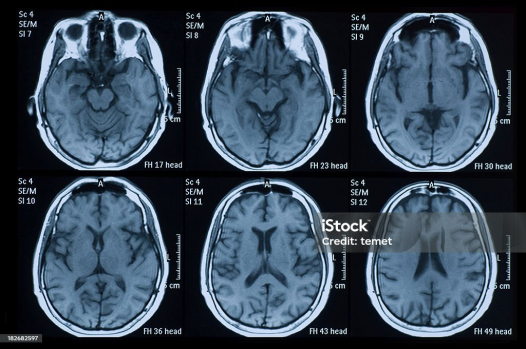
We also processed a free medical MRI image available on iStockphoto.com, which offers royalty-free visual content. This image is available at this link
https://www.istockphoto.com/fr/photo/cerveau-gm182682597-12321941?searchscope=image%2Cfilm
Figure 2. Processed image (MRI).
1) Image size: 200×200 pixels, 256x256pixels, 300x300pixels, 400x400pixels and 512x512pixels
2) Programming environment: MATLAB 2023
3) Hardware specifications: CPU: Intel(R) Core i7-9750H, GPU: NVIDIA GetForce RTX 2060, RAM: 16Go
There are two experimental scenarios:
1) Scenario 1: Performance evaluation of the proposed algorithms across different sampling rates and on two distinct images. The performance metrics are the Structural Similarity Index (SSIM) and image reconstruction time. Note that the image size was fixed at 200 × 200 pixels.
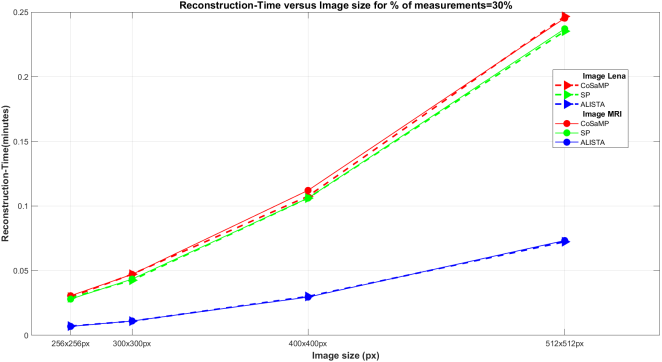
2) Scenario 2: Performance evaluation of the proposed algorithms on images of varying sizes (256 × 256, 300 × 300, 400 × 400, and 512 × 512 pixels), with the sampling rate fixed at 30%. This value was chosen to assess whether our algorithms can still successfully reconstruct the image even from a relatively small number of measurements. The experiment is again conducted on two different images, using SSIM and reconstruction time as performance criteria.
Table 1 presents the images reconstructed by the CoSaMP, SP, and ALISTA algorithms for sampling rates ranging from 10% to 80%.
Table 1. Images reconstructed for Lena (scenario 1).

M(%)

CoSaMP

SP

ALISTA

10

20

30

40

50

60

70

80

The results obtained are summarized in Table 2.
Table 2. Summary of the results for Lena (scenario 1).

M(%)

SSIM

Reconstruction Time (minute)

CoSaMP

SP

ALISTA

CoSaMP

SP

ALISTA

10%

0.94261

0.94261

0.94261

0.022308

0.01603

0.010908

20%

0.94655

0.94655

0.9469

0.033274

0.052603

0.017301

30%

0.95713

0.95713

0.959

0.10555

0.09266

0.02679

40%

0.96478

0.96478

0.97001

0.34581

0.14171

0.033439

50%

0.96867

0.96867

0.97818

0.3305

0.067831

0.046935

60%

0.97064

0.97064

0.98294

0.13129

0.079955

0.043497

70%

0.97201

0.97201

0.98669

0.14576

0.085724

0.055462

80%

0.97492

0.97492

0.99346

0.17644

0.10219

0.065619

Table 3 presents the images reconstructed by the CoSaMP, SP, and ALISTA algorithms for sampling rates ranging from 10% to 80% for MRI image.
Table 3. Images reconstructed for MRI Image (scenario 1).

M(%)

CoSaMP

SP

ALISTA

10

20

30

40

50

60

70

80

The results obtained are summarized in Table 4.
Table 4. Summary of the results for MRI Image (scenario 1).

M(%)

SSIM

Reconstruction Time (minute)

CoSaMP

SP

ALISTA

CoSaMP

SP

ALISTA

10%

0.88781

0.88781

0.88781

0.010831

0.011568

0.0032803

20%

0.90178

0.90178

0.90237

0.014474

0.013024

0.0034306

30%

0.90777

0.90777

0.91102

0.015925

0.015378

0.0045395

40%

0.91692

0.91692

0.92481

0.019353

0.017123

0.003768

50%

0.92587

0.92587

0.9421

0.019428

0.018171

0.0037952

60%

0.92852

0.92852

0.95151

0.021164

0.02057

0.0040424

70%

0.93459

0.93459

0.96569

0.023218

0.021628

0.0039186

80%

0.94007

0.94007

0.98024

0.024805

0.023371

0.003802

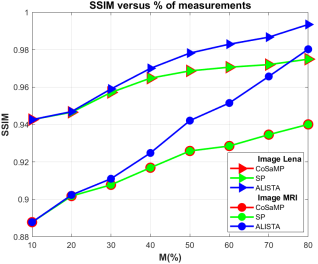
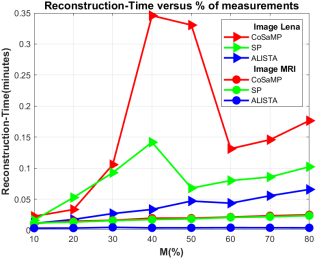
In order to interpret the results, we decided to present these values in the form of curves (Figures 3 and 4).
Figure 3. SSIM vs% of measurements.
Figure 4. Reconstruction time vs% of measurements.
Figure 3 compares the performance of three image reconstruction algorithms in terms of image quality, as quantified by the Structural Similarity Index (SSIM), for two types of images: Lena and an MRI scan. As expected, SSIM values increase with the percentage of measurements for all algorithms and both images reflecting the intuitive principle that greater measurement density provides more information, leading to higher-quality reconstructions. Notably, ALISTA consistently outperforms the other methods, achieving the highest SSIM scores of approximately 0.98 for the MRI image and 0.99 for Lena across all sampling rates. Indeed, unlike CoSaMP and SP, which are greedy algorithms, ALISTA is based on learning approach; it learns optimal parameters from training data, enabling it to adapt to the specific characteristics of images, which explains its superior performance.
Figure 4 illustrates the reconstruction time (in minutes) as a function of the sampling rate for the three algorithms CoSaMP, SP, and ALISTA applied to both a natural image (Lena) and a medical image (MRI). ALISTA demonstrates remarkably low computational time, consistently staying below 0.06 minutes (i.e., 3,6 seconds), irrespective of the measurement percentage or image type. This stability makes ALISTA by far the most computationally efficient algorithm in terms of speed. In stark contrast, both CoSaMP and SP exhibit significantly longer reconstruction times that increase markedly with the number of measurements, highlighting their greater computational burden and sensitivity to sampling density. This difference stems from the fundamentally distinct nature of these algorithms: ALISTA is based on a learning-based approach, whereas CoSaMP and SP are iterative greedy algorithms that require iterative selection and update steps whose convergence may vary depending on measurement density and image structure. Thus, ALISTA offers a dual advantage: high reconstruction quality (as previously demonstrated) and minimal computational cost, making it particularly well-suited for real-time or embedded applications where speed is critical.
For the second scenario, Tables 5 and 6 show the evaluation of the algorithms across different image sizes.
Table 5. Summary of the results for Lena Image (scenario 2).

Image size

SSIM

Reconstruction Time (minute)

CoSaMP

SP

ALISTA

CoSaMP

SP

ALISTA

256×256px

0.95736

0.95736

0.96104

0.029563

0.029002

0.0071062

300×300px

0.95653

0.95653

0.96219

0.047249

0.042565

0.010946

400×400px

0.95826

0.95826

0.96694

0.10758

0.10609

0.030053

512×512px

0.96

0.96

0.97371

0.24659

0.23517

0.072343

Table 6. Summary of the results for Lena Image (scenario 2).

Image size

SSIM

Reconstruction Time (minute)

CoSaMP

SP

ALISTA

CoSaMP

SP

ALISTA

256×256px

0.91951

0.91951

0.92539

0.030584

0.027998

0.006887

300×300px

0.93109

0.93109

0.93814

0.047103

0.043459

0.011053

400×400px

0.94246

0.94246

0.9502

0.11207

0.10611

0.029529

512×512px

0.95457

0.95457

0.96139

0.24525

0.23701

0.073263

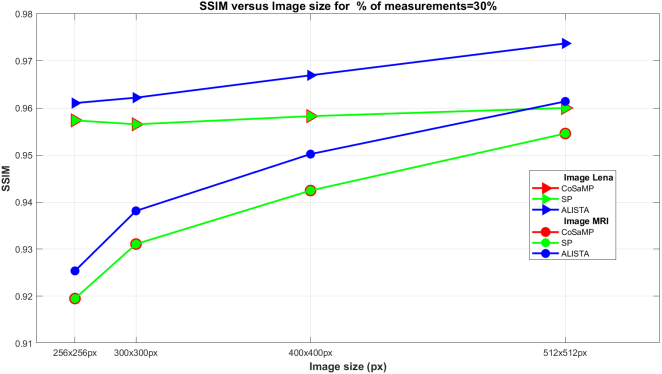
In order to interpret the results, we decided to present these values in the form of curves (Figures 5 and 6).
Figure 5. SSIM vs Image size for% of measurements=30%.
Figure 5 illustrates the reconstruction quality (SSIM) as a function of image size (in pixels), for a fixed measurement rate of 30%. It can be observed that, for all algorithms and all image types, SSIM increases with image size. Indeed, algorithms benefit from the greater structural richness and higher resolution offered by larger images. ALISTA clearly outperforms the other two algorithms across different resolutions and image types, achieving an SSIM > 0.973 for Lena and > 0.96 for MRI at 512×512 px. In contrast, CoSaMP and SP exhibit lower performance and are more sensitive to image content. Unlike classical greedy algorithms such as CoSaMP and SP, which rely heavily on iterative optimization, ALISTA uses predefined parameters (weight matrices and thresholds) learned from diverse image datasets, enabling robust reconstruction even on large-scale images.
Figure 6. Reconstruction-Time vs Image size for% of measurements=30%.
Figure 6 shows the reconstruction time (in minutes) as a function of image size (in pixels), for a fixed measurement rate of 30%. It can be observed that ALISTA exhibits an extremely low and nearly linear reconstruction time, remaining below 0.07 minute (4,2 seconds) even for a 512×512 px image, confirming its very high computational efficiency. In contrast, CoSaMP and SP show significantly higher reconstruction times that increase sharply with resolution, reaching nearly 0.24 minute (14 seconds). ALISTA is faster than CoSaMP and SP primarily because it relies on a deterministic and non-iterative architecture. Unlike CoSaMP and SP which are iterative greedy algorithms requiring, at each iteration, costly operations such as selecting the most correlated atoms, solving a least-squares problem over the estimated support, and updating the solution, ALISTA executes a fixed and predefined number of steps, where the weight matrices and thresholds are learned once and for all on a training dataset. Moreover, the reconstruction time for both Lena and MRI images is nearly identical for ALISTA, indicating that this algorithm is insensitive to image type and size.
5. Originality and Our Contribution to the Research
In compressive sensing, when processing images, the conventional Discrete Wavelet Transform (DWT) is typically used to obtain a sparse representation. However, this transform is computationally slow due to its convolution operations. In this paper, we propose a novel approach based on the Lifting Wavelet Transform (LWT) to address this limitation. Moreover, the originality and our key contribution lie in the methodology adopted for compressive sensing. Specifically, the LWT of an image yields four components:
1) CA: A reduced and blurred version of the original image
2) LH: Vertical details
3) HL: Horizontal details
4) HH: Diagonal details
According to our studies, the LH, HL, and HH components are inherently sparse matrices, unlike the CA component. This observation led us to apply compressive sensing only to these three detail components while leaving the CA component untouched. We therefore evaluated the performance of this proposed approach using various reconstruction algorithms. In this article, we use the Lifting Wavelet Transform (LWT) with the Symlet 8 (sym8) wavelets.
6. Conclusion
This study demonstrates the effectiveness of a compressive sensing (CS) that combines the Lifting Wavelet Transform (LWT) using Symlet 8 (sym8) wavelets with three reconstruction algorithms: Subspace Pursuit (SP), Compressive Sampling Matching Pursuit (CoSaMP), and Analytic Learned ISTA (ALISTA). Experimental results, obtained on both standard (Lena) and medical (MRI) images, clearly show that ALISTA significantly outperforms SP and CoSaMP in both reconstruction quality (measured by SSIM) and computational efficiency. At an 80% sampling rate, ALISTA achieves an SSIM of 0.99346, compared to 0.98024 for the other two methods, while requiring less than 4 seconds for reconstruction versus over 20 seconds in certain cases for CoSaMP. Moreover, ALISTA maintains stable and fast performance even at low sampling rates (10%) and for image resolutions up to 512 × 512 pixels, highlighting its robustness and adaptability. This superiority stems from its learning-based approach, where thresholds and weight matrices are pre-learned, thereby avoiding the computationally expensive iterative loops characteristic of classical greedy methods. Finally, using LWT instead of the conventional Discrete Wavelet Transform (DWT) not only reduces algorithmic complexity but also effectively preserves the sparsity of wavelet coefficients. The combination of ALISTA with the LWT/sym8 transform is highly promising for real-time applications such as telemedicine, embedded vision, or remote sensing, where both high accuracy and minimal latency are critical.
Although this work employs Symlet 8 (sym8) within the Lifting Wavelet Transform (LWT) framework to achieve efficient sparse representation, additional improvements could be realized by integrating adaptive or learned wavelet-like transforms for instance, through neural network-based approaches jointly optimized with the reconstruction process. Furthermore, substituting the random Gaussian or subsampled identity measurement matrix with structured sensing operators such as partial Fourier or Hadamard matrices may lower hardware complexity and enhance data acquisition speed.
Abbreviations

ALISTA

Analytic Learned Iterative Shrinkage Thresholding Algorithm

CoSaMP

Compressive Sampling Matched Pursuit

DWT

Discrete Wavelet Transform

LWT

Lifting Wavelet Transform

MRI

Magnetic Resonance Imaging

MSE

Mean Squared Error

PSNR

Peak Signal-to-Noise Ratio

SSIM

Structural Similarity Index

SP

Subspace Pursuit

Author Contributions
Sarobidy Nomenjanahary Razafitsalama Fin Luc: Investigation, Methodology
Marie Emile Randrianandrasana: Supervision, Validation
Hariniony Bienvenu Rakotonirina: Conceptualization, Formal Analysis, Investigation, Methodology, Project administration, Resources, Software, Supervision, Validation, Writing – original draft, Writing – review & editing
Conflicts of Interest
The authors declare no conflicts of interest.
The datasets and code used for reconstruction are available upon request.
References
[1] Needell, D., & Tropp, J. A. CoSaMP: Iterative signal recovery from incomplete and inaccurate samples. Applied and Computational Harmonic Analysis, 2009, 26(3), 301-321.
[2] Chen, X., Liu, J., Wang, Z., & Yin, W. Theoretical linear convergence of unfolded ISTA and its practical weights and thresholds. Advances in Neural Information Processing Systems, 2018, 31, 9061-9071.
[3] Sweldens, W. The Lifting Scheme: A Custom-Design Construction of Biorthogonal Wavelets. Applied and Computational Harmonic Analysis, vol. 3, no. 2, pp. 186-200, 1996.
[4] Daubechies, I.; Sweldens, W. Factoring Wavelet Transforms into Lifting Steps. Journal of Fourier Analysis and Applications, vol. 4, no. 3, pp. 247-269, 1998.
[5] Zhang, J., Liu, Y., & Zhang, W. (2023). Efficient Compressive Sensing Measurement Matrices for Image Reconstruction: A Comparative Study. IEEE Transactions on Computational Imaging, 9, 412-425.
[6] Chen, X., Liu, J., Wang, Z., & Yin, W. (2023). ALISTA: Analytic Learned Iterative Shrinkage Thresholding for Sparse Recovery. IEEE Transactions on Signal Processing, 71, 1285-1299.
[7] Zhang, J., Liu, Y., & Zhang, W. (2024). Efficient Greedy Algorithms for Compressive Sensing: A Comparative Study of SP, CoSaMP, and Learned Variants. Signal Processing, 215, 109287.
[8] Claypoole, R. L., Davis, G. M., Sweldens, W., and Baraniuk, R. G. Nonlinear Wavelet Transforms for Image Coding via Lifting. IEEE Transactions on Image Processing, 12(12): 1449-1459, 2003.
[9] Arivazhagan, S., Prema, G.,(2025) Novel Image Fusion based on Hybrid DWT and LWT Transform, Journal of Advanced Research in Dynamical and Control Systems,
[10] Wang, Y., Liu, Z., & Chen, H. (2024). Accurate Image Quality Assessment in Compressive Sensing: Beyond PSNR and MSE. IEEE Transactions on Image Processing, 33, 2105-2118.
[11] Gupta, A., & Singh, R. (2023). Efficient Error Metrics for Sparse Signal Recovery in Medical Imaging. Signal Processing, 212, 109145.
[12] Liu, Y., Zhang, H., & Wang, Q. (2024). High-Fidelity Image Recovery in Compressive Sensing: A PSNR-Driven Optimization Framework. IEEE Transactions on Multimedia, 26, 3012-3025.
[13] Simoes, W., De Sa, M., (2024). PSNR and SSIM: Evaluation of the Imperceptibility Quality of Images Transmitted over Wireless Networks.
[14] Wang, Z., & Bovik, A. C. (2023). Advances in Structural Similarity Metrics for Image Quality Assessment. IEEE Transactions on Pattern Analysis and Machine Intelligence, 45(8), 10212-10227.
[15] Li, H., Liu, Y., & Zhang, J. (2024). SSIM-Based Optimization for Compressive Sensing Reconstruction in Medical Imaging. Medical Image Analysis, 92, 102987.
Cite This Article
  • APA Style

    Luc, S. N. R. F., Randrianandrasana, M. E., Rakotonirina, H. B. (2025). Image Reconstruction in Compressive Sensing Using Symlet 8 (sym8) and Lifting Wavelet Transforms with SP, CoSaMP, and ALISTA Algorithms. American Journal of Information Science and Technology, 9(4), 277-290. https://doi.org/10.11648/j.ajist.20250904.12

    Copy | Download

    ACS Style

    Luc, S. N. R. F.; Randrianandrasana, M. E.; Rakotonirina, H. B. Image Reconstruction in Compressive Sensing Using Symlet 8 (sym8) and Lifting Wavelet Transforms with SP, CoSaMP, and ALISTA Algorithms. Am. J. Inf. Sci. Technol. 2025, 9(4), 277-290. doi: 10.11648/j.ajist.20250904.12

    Copy | Download

    AMA Style

    Luc SNRF, Randrianandrasana ME, Rakotonirina HB. Image Reconstruction in Compressive Sensing Using Symlet 8 (sym8) and Lifting Wavelet Transforms with SP, CoSaMP, and ALISTA Algorithms. Am J Inf Sci Technol. 2025;9(4):277-290. doi: 10.11648/j.ajist.20250904.12

    Copy | Download

  • @article{10.11648/j.ajist.20250904.12,
      author = {Sarobidy Nomenjanahary Razafitsalama Fin Luc and Marie Emile Randrianandrasana and Hariony Bienvenu Rakotonirina},
      title = {Image Reconstruction in Compressive Sensing Using Symlet 8 (sym8) and Lifting Wavelet Transforms with SP, CoSaMP, and ALISTA Algorithms},
      journal = {American Journal of Information Science and Technology},
      volume = {9},
      number = {4},
      pages = {277-290},
      doi = {10.11648/j.ajist.20250904.12},
      url = {https://doi.org/10.11648/j.ajist.20250904.12},
      eprint = {https://article.sciencepublishinggroup.com/pdf/10.11648.j.ajist.20250904.12},
      abstract = {This paper proposes an efficient image reconstruction for compressive sensing (CS) that combines the Lifting Wavelet Transform (LWT) using Symlet 8 (sym8) wavelets with three reconstruction algorithms: Subspace Pursuit (SP), Compressive Sampling Matching Pursuit (CoSaMP), and the Analytic Learned Iterative Shrinkage Thresholding Algorithm (ALISTA). Unlike the conventional Discrete Wavelet Transform (DWT) which relies on computationally intensive convolution operations the LWT provides a faster sparse representation while preserving the sparsity crucial for CS. The proposed approach leverages a key insight: among the four subbands produced by the LWT namely the approximation (CA) and the detail coefficients (LH, HL, HH) only the latter three are inherently sparse. Therefore, compressive sensing is applied exclusively to these detail subbands, while the CA subband is left uncompressed to retain essential low-frequency information. Experiments were conducted on both a natural test image (Lena) and a medical MRI scan, across image resolutions ranging from 200×200 to 512×512 pixels and sampling rates from 10% to 80%. Performance was assessed using the Structural Similarity Index (SSIM) and reconstruction time. Results consistently demonstrate that ALISTA significantly outperforms SP and CoSaMP in both reconstruction fidelity and computational efficiency. At an 80% sampling rate, ALISTA achieves SSIM values of 0.99346 for Lena and 0.98 for the MRI image, compared to approximately 0.97 and 0.94, respectively, for the other two methods. Furthermore, ALISTA maintains remarkably low reconstruction times under 4 seconds even for 512×512-pixel images. These findings confirm that the ALISTA + LWT/sym8 combination offers the best trade-off between image quality and speed, exhibiting robustness across different image types and scales.},
     year = {2025}
    }
    

    Copy | Download

  • TY  - JOUR
    T1  - Image Reconstruction in Compressive Sensing Using Symlet 8 (sym8) and Lifting Wavelet Transforms with SP, CoSaMP, and ALISTA Algorithms
    AU  - Sarobidy Nomenjanahary Razafitsalama Fin Luc
    AU  - Marie Emile Randrianandrasana
    AU  - Hariony Bienvenu Rakotonirina
    Y1  - 2025/12/09
    PY  - 2025
    N1  - https://doi.org/10.11648/j.ajist.20250904.12
    DO  - 10.11648/j.ajist.20250904.12
    T2  - American Journal of Information Science and Technology
    JF  - American Journal of Information Science and Technology
    JO  - American Journal of Information Science and Technology
    SP  - 277
    EP  - 290
    PB  - Science Publishing Group
    SN  - 2640-0588
    UR  - https://doi.org/10.11648/j.ajist.20250904.12
    AB  - This paper proposes an efficient image reconstruction for compressive sensing (CS) that combines the Lifting Wavelet Transform (LWT) using Symlet 8 (sym8) wavelets with three reconstruction algorithms: Subspace Pursuit (SP), Compressive Sampling Matching Pursuit (CoSaMP), and the Analytic Learned Iterative Shrinkage Thresholding Algorithm (ALISTA). Unlike the conventional Discrete Wavelet Transform (DWT) which relies on computationally intensive convolution operations the LWT provides a faster sparse representation while preserving the sparsity crucial for CS. The proposed approach leverages a key insight: among the four subbands produced by the LWT namely the approximation (CA) and the detail coefficients (LH, HL, HH) only the latter three are inherently sparse. Therefore, compressive sensing is applied exclusively to these detail subbands, while the CA subband is left uncompressed to retain essential low-frequency information. Experiments were conducted on both a natural test image (Lena) and a medical MRI scan, across image resolutions ranging from 200×200 to 512×512 pixels and sampling rates from 10% to 80%. Performance was assessed using the Structural Similarity Index (SSIM) and reconstruction time. Results consistently demonstrate that ALISTA significantly outperforms SP and CoSaMP in both reconstruction fidelity and computational efficiency. At an 80% sampling rate, ALISTA achieves SSIM values of 0.99346 for Lena and 0.98 for the MRI image, compared to approximately 0.97 and 0.94, respectively, for the other two methods. Furthermore, ALISTA maintains remarkably low reconstruction times under 4 seconds even for 512×512-pixel images. These findings confirm that the ALISTA + LWT/sym8 combination offers the best trade-off between image quality and speed, exhibiting robustness across different image types and scales.
    VL  - 9
    IS  - 4
    ER  - 

    Copy | Download

Author Information
  • Department of Signal, Doctoral School of Engineering and Innovation Sciences and Techniques, Antananarivo, Madagascar

    Research Fields: Mathematics, Algorithmics, Compressive Sensing, Artificial intelligence, Data compression

  • Department of Telecommunication, High School Polytechnic of Antsirabe, Antsirabe, Madagascar

    Research Fields: Telecommunication, Signal processing, Compressive Sensing, Radar, Electromagnetic wave

  • Department of Telecommunication, High School Polytechnic of Antsirabe, Antsirabe, Madagascar