Research Article | | Peer-Reviewed

A Comparative Study of Print and Digital Learning Resource Preferences Among Competitive Exam Aspirants at Kannada University

Received: 29 October 2025     Accepted: 8 November 2025     Published: 9 December 2025
Views:       Downloads:
Abstract

This study investigates the preferences for learning resources among competitive exam aspirants at Kannada University, emphasizing the comparative utilization of print versus digital materials. The results indicate a significant trend towards the adoption of digital resources, with platforms such as YouTube coaching channels, online quizzes, and e-books being identified as the most utilized tools. These digital materials are particularly valued for their accessibility, interactivity, and convenience, aligning with the evolving learning demands of students preparing for competitive examinations. Demographic analysis reveals notable variations in resource usage: male students, those residing in urban areas, and individuals from the arts stream demonstrate a higher propensity to engage with digital learning platforms relative to other groups. Nonetheless, despite the increasing preference for online tools, traditional resources such as printed competitive exam books and academic research publications retain importance and continue to be utilized extensively for comprehensive study and conceptual grasp. In light of these findings, the study recommends that Kannada University enhance its library and digital infrastructure to expand access to e-resources, alongside offering targeted digital literacy training. Additionally, integrating online learning platforms and interactive tools within the university’s academic support framework could significantly improve student preparedness for competitive examinations, thereby fostering a more comprehensive and effective learning environment.

Published in American Journal of Information Science and Technology (Volume 9, Issue 4)
DOI 10.11648/j.ajist.20250904.13
Page(s) 291-297
Creative Commons

This is an Open Access article, distributed under the terms of the Creative Commons Attribution 4.0 International License (http://creativecommons.org/licenses/by/4.0/), which permits unrestricted use, distribution and reproduction in any medium or format, provided the original work is properly cited.

Copyright

Copyright © The Author(s), 2025. Published by Science Publishing Group

Keywords

Competitive Exam Aspirants, Learning Resources, Digital Resources, Print Materials, E-Learning, Library Services

1. Introduction
The demand for competitive exams has increased, leading students to explore various study resources, including digital technologies like e-books, online journals, video lectures, and educational apps. The Kannada University Library faces challenges in balancing digital and print materials, as well as factors like digital literacy, availability of materials, internet access, and reading habits . In the evolving education sector, digital technologies like e-books and video lectures enhance competitive exam preparation, yet traditional print resources are still vital for a thorough understanding. Learners' choices between digital and print formats are influenced by availability, preference, and socio-economic status. A study at Kannada University investigates the resource preferences of competitive exam aspirants, emphasizing the impact of demographics such as age, gender, and residence. The results aim to improve library services, digital infrastructure, and academic support to bolster exam preparation strategies. The study investigates the preferences of competitive exam aspirants at Kannada University, focusing on the dichotomy between physical books and digital devices. While print materials are considered reliable and authoritative, digital resources offer advantages like instant access, interactivity, and portability. The effectiveness and user acceptance of these resources can vary depending on individual learning styles, technology availability, and content quality perceptions. The research aims to provide insights into evolving study habits and inform the development of educational resources tailored to aspirants' needs in a rapidly digitizing educational environment .
2. Review of Literature
Literature reviews are essential in academic writing as they offer a comprehensive overview of existing research, helping to contextualize new studies within the current state of knowledge. They assist in narrowing down research topics, explaining objectives and methodologies, and identifying scholarly contributions.
Ishola et al. (2016) evaluated the accessibility and use of electronic resources in private universities in South West Nigeria, finding that internet services and e-resources were readily available and widely used for coursework, research, teaching, and general reading. Users cited quick access, reliability, and usefulness as key benefits. The study recommended that the National Universities Commission ensure functional networking and database subscriptions in all universities .
Similarly, Uloaku (2017) studied internet use among researchers in special libraries in Kaduna State, reporting that email services were the most frequently used for communication and data retrieval. However, challenges such as slow internet speed, connection failures, and outdated systems were prevalent. Recommendations included upgrading connectivity, providing modern computers, and establishing maintenance programs .
Ojedokun and Emmanuel (2003) examined internet usage among 216 academic staff at the University of Botswana. While many respondents had strong skills in searching for literature and data, they lacked proficiency in applying ICT tools for teaching activities such as sharing lecture notes or using online platforms. The authors emphasized the need for staff training to maximize the benefits of ICT investments .
Baruah and Hangsingh (2012) discussed the growing relevance of digital competencies in India’s job market, highlighting the importance of online searching, internet literacy, and skills in managing e-resources and information retrieval systems .
Danner and Pessu (2013) investigated ICT competencies among teacher preparation students at the University of Benin, Nigeria. The study found a significant variance in ICT skill levels, particularly among those who had taken formal computer courses. Interestingly, there was no significant difference in ICT competencies between male and female students .
Jeyshankar, Nachiappan, and Lavanya (2018) analyzed information retrieval skills among 252 postgraduate students from four faculties. Female students were found to possess higher retrieval skills, particularly in using electronic catalogues by author, title, and shelf searches. Both genders showed a high mean score (4.54), with males reaching a peak of 4.35 on specific skills .
Jeyshankar and Vellaichamy (2017) assessed the information access skills of women faculty members at Mother Teresa Women’s University and its affiliated colleges. Of the 254 participants, 95.2% reported being able to access both print and electronic reference sources, 92.5% could comprehend texts, and over 80% could summarize or identify similar information, indicating strong foundational information literacy .
3. Objectives
1) To assess the level of digital literacy among competitive exam aspirants.
2) To analyze the usage patterns of print and digital learning materials.
3) To determine the level of online searching skills among the respondents.
4) To explore the purposes of using library materials in the digital age.
4. Methodology
This study examines digital literacy, internet usage, and resource preferences among competitive exam aspirants at Kannada University. Data collected from approximately 210 students via a structured questionnaire and informal interviews revealed insights into demographic variations. Quantitative analysis used descriptive statistics shown in tables and graphs. Key conclusions emphasize the significance of digital literacy in resource selection, while noting limitations related to the study's focus and biases from self-reported data.
Scope of the Study
This study investigates the learning resource preferences of competitive exam aspirants at Kannada University, comparing traditional print materials with digital resources. It assesses the types of resources used (textbooks, e-books, mobile apps, online platforms), their frequency and purposes, and the factors influencing these preferences, such as accessibility, convenience, cost, and perceived effectiveness. Additionally, it examines the role of university libraries, digital literacy, and infrastructural support in shaping these choices. Data will be gathered from aspirants across various academic disciplines to provide a thorough understanding of their learning behaviors in the context of exam preparation.
5. Data Analysis and Interpretation
Table 1. Demographic profile of the respondents (N=210).

Sl. No.

Category

Description

Gender

100.%

Male

Female

Total

154

56

210

1

Age

Below 25

53

32

85

40.47%

25-30

77

19

96

45.47%

31-35

24

5

29

13.80%

Total

154

56

210

100%

2

Course

PG

89

37

126

34.29%

PhD

65

19

84

3.81%

Total

154

56

210

100%

3

Subject

Arts

69

41

110

20.00%

Science

45

10

55

21.90%

Commerce

40

5

45

58.10%

Total

154

56

210

100%

4

Location

Rural

65

26

91

35.24%

Urban

89

30

119

64.76%

Total

154

56

210

100%

Table 1 shows the Kannada University Library's socio-demographic profile shows a majority of male respondents (73.33%), with 45.71% over 25 years old. The largest age group is under 25, followed by the youngest (40.48%) and smallest (13.81%). Most respondents are enrolled in postgraduate courses and PhD candidates, with arts being the most popular subject (52.38%). Females are more prevalent in arts.
Table 2. Basic knowledge of digital literacy among the respondents (N=210).

Sl. No

Knowledge/Skill Area

Yes (%)

No (%)

1

Knowledge of basic hardware components & functions

156 (74.28%)

54 (25.71%)

2

Understanding file format extensions

167 (79.52%)

43 (20.47%)

3

Ability to convert file formats

77 (36.66%)

133 (63.33%)

4

Scanning text and images

123 (58.57%)

87 (41.42%)

5

Use of shortcut keys

159 (75.71%)

51 (24.28%)

Table 2 shows the study reveals that most participants are familiar with basic hardware components and functions, with a majority of them being familiar with file format extensions. However, most lack skills in converting file formats, with a significant gap in the area of scanning text and images. The use of shortcut keys is also a significant area of expertise, with 75.71% of participants having strong knowledge of these keys. The most common weakness is file format conversion, with 63% of participants indicating they lack this skill, suggesting a need for targeted training.
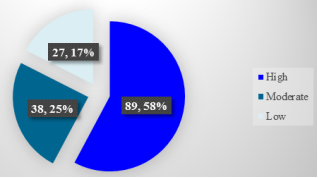
Figure 1 the study reveals that out of 210 respondents, 154 (73.33%) were male and 56 (26.66%) were female in terms of digital literacy skills. Male respondents had high skills (57.8%), moderate (24.7%), and low (17.5%), while female respondents had high (13.64%), moderate (24.7%), and low (17.5%) skills. The chi-square test showed no significant association between gender and digital literacy skills, indicating the null hypothesis.
Figure 1. Level of knowledge and ability in digital literacy.
Table 3. Purpose of Internet usage (N=210).

Sl. No

Usage

Frequently

Occasionally

Rarely

1.

General Browsing

10 (4.7)

12 (5.71)

05 (2.38)

2.

online e- online e- resources

13 (6.19)

19 (9.04)

12 (5.71)

3.

Apply for online application

21 (10)

12 (5.71)

07 (3.33)

4.

Coaching classes listening through YouTube

22 (10.47)

19 (9.04)

04 (1.90)

5.

Online Mock test

18 (8.57)

25 (11.90)

11 (5.23)

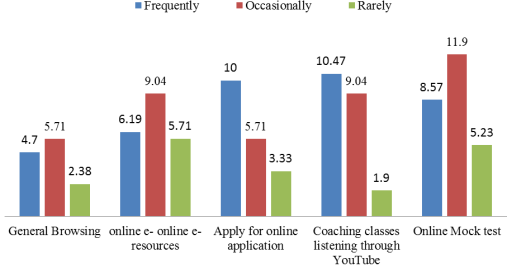
Figure 2. Purpose of Internet usage.
Table 3 shows the study of 210 respondents found that they use digital learning tools like YouTube classes and mock tests for various purposes. General browsing has the lowest usage at 4.7%, followed by moderate usage of online e-resources at 6.19% and application-related tasks at 3.33%. These usage patterns align with students' academic and career responsibilities. YouTube-based coaching classes are the most frequently used online tool, with 10.47% of students using them. Online mock tests are also widely used, with 8.57% using them occasionally, especially during exam periods. Overall, students' internet usage is influenced by their academic and career responsibilities .
Table 4. Level of Online searching skill (N = 210).

Sl. No

Proficiency Level

Male

Female

Total

%

1

Very Good

34

16

50

23.80%

2

Good

51

18

69

32.85%

3

Average

33

13

46

21.90%

4

Poor

22

4

26

12.38%

5

Very Poor

16

3

19

9.04%

Total

154

56

210

100%

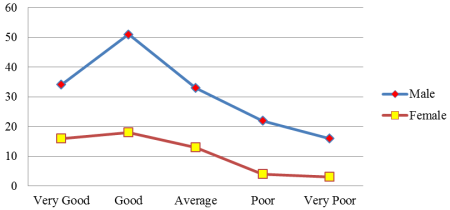
Figure 3. Purpose of Internet usage.
Table 4 shows the level of Online searching skills of the respondents. The analysis reveals that 16.19 respondents have good internet searching skills, followed by 22.85% holding average skills and 17.1% possessing very good skills. Gender-wise, 60.3% of male respondents and 56.2% of female respondents have good internet searching skills, followed by 23.3% and 21.9% of male and female respondents, and 15.15% and 21.9% of female respondents possess very good Online searching skills .
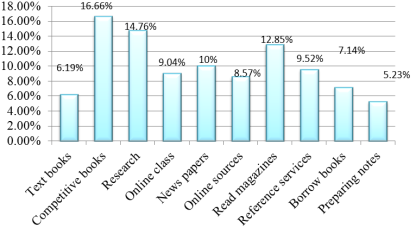
Figure 4. Purpose of using of library materials.
Figure 3 shows the study at Kannada University analyzed the study reveals that competitive books (16.66%) are the most preferred resource for competitive exam aspirants, followed by research (14.76%) and reading magazines (12.85%). Online classes and online sources make up 17.61% of the total, reflecting a moderate reliance on digital learning. Newspapers (10%) and reference services (9.52%) emphasize the importance of traditional media and academic support services. Textbooks (6.19%) and borrowing books (7.14%) show that core academic materials may be less relevant for competitive exam preparation. Preparing notes (5.23%) is the lowest, possibly suggesting a preference for ready-made materials over self-made notes .
6. Major Findings
1) The widely held of respondents are under 25, with 60% being postgraduates and 40% being Ph.D. candidates, with arts being the most pursued subject, with female students being more concentrated.
2) The study reveals No's enhanced understanding of digital literacy, including hardware components; file format extensions, conversion skills, scanning, and shortcut keys, emphasizing its importance in various life aspects.
3) The study found that males had the highest digital literacy skills at 57.8%, followed by females at 13.64%, 24.7%, and 61.66%, rejecting the null hypothesis.
4) Students primarily use the internet for academic and career-related activities, with low engagement activities like browsing and moderate engagement activities like online resources, high engagement activities like YouTube-based coaching classes.
5) The study reveals that 16.19 respondents have excellent online search skills, with 22.85% having average skills and 17.1% having very good skills, and 60.3% and 56.2% having good skills respectively.
6) A Kannada University study reveals competitive books, research, and reading magazines are preferred exam resources, with online classes accounting for 17.61%, and traditional media and academic support services less relevant.
7. Suggestions
1) To enhance inclusivity, digital literacy programs should focus on rural and female users.
2) Libraries should provide workshops to assist users with file format conversions and advanced software.
3) Support these programs through institutional funding or government assistance.
4) Aspirants should be online mock tests and structured e-learning tools use.
8. Conclusion
The study "Turning Pages or Tapping Screens" examined the preferences, accessibility, and effectiveness of digital and print study resources among competitive exam aspirants at Kannada University Hampi Library. The data from 210 respondents revealed varying levels of digital literacy, gender-based usage trends, and familiarity with digital tools. The majority had moderate to high digital competency, but traditional print materials were still important due to their reliability and minimal distractions. There was no significant correlation between gender and digital literacy, suggesting equitable engagement with digital platforms. The study advocates for a blended learning approach that integrates both digital and print resources to optimize exam preparation outcomes. The study concludes that competitive exam aspirants are increasingly integrating digital resources into their study routines, but a hybrid approach combining both forms is most prevalent.
Abbreviations

PG

Post Graduate

PHD

Doctor of Philosophy

ARTS

Refers to the Academic Stream Covering Humanities and Social Sciences

COMMERCE

Academic Stream Related to Business, Finance, and Economics

ICT

Information And Communication Technology

E-Learning

Electronic Learning

YOUTUBE

Free Online Video-Sharing Platform

ONLINE CLASSES

Virtual Learning Sessions Conducted Over The Internet

INTERNET

Global Network Of Computers

Author Contributions
Shivaraja Ramachandragouda: Conceptualization, Data curation, Formal Analysis, Funding acquisition, Investigation, Methodology, Resources, Software, Supervision, Validation, Visualization, Writing – original draft,
Purushothmagowda M.: Conceptualization, Data curation, Formal Analysis, Funding acquisition, Investigation, Methodology, Project administration, Resources, Software, Supervision, Validation, Visualization, Writing – original draft
Umesha Naik: Conceptualization, Data curation, Formal Analysis, Funding acquisition, Investigation, Methodology, Software, Supervision, Validation, Visualization, Writing – original draft
Renuka: Conceptualization, Data curation, Formal Analysis, Funding acquisition, Investigation, Methodology, Project administration, Resources, Software, Supervision, Validation, Visualization, Writing – original draft, Writing – review & editing
Conflicts of Interest
The authors declare no conflicts of interest.
References
[1] Al-Ansari, H. (2006). Internet use by the faculty members of Kuwait University. The Electronic Library, 24(6), 791-803.
[2] Ayoku, A., Ojedokun, A., & Owolab, E. O. (2003). Internet access competence and the use of the internet for teaching and research activities by University of Botswana academic staff. African Journal of Library, Archives and Information Science, 13(1), 43-53.
[3] Baruah, B. G., &Hangsing, P. (2013). Relevance of the rising job market for LIS professionals versus competencies needed with reference to Indian context. Trends in Information Management (TRIM), 8(2), 54-74.
[4] Danner, R. B., &Pessu, C. O. (2013). A survey of ICT competencies among students in teacher preparation programmes at the University of Benin, Benin City, Nigeria. Journal of Information Technology Education: Research, 12, 33-49.
[5] Ishola, B. C., Aboyade, M. A., Ojokuku, B. Y., &Akintade, K. O. (2016). Availability, accessibility and use of e-resources in selected private universities in South West, Nigeria. Middle Belt Journal of Library and Information Science, 14, 110-121.
[6] Jeyshankar, R., Nachiappan, N., & Suresh, M. (2016). Access and use of social networking sites (SNSs) among the postgraduate students of rural-based colleges of Tamil Nadu, India - A study. SRELS Journal of Information Management, 53(3), 237-241.
[7] Kleimola, R., &Leppisaari, I. (2022). Learning analytics to develop future competences in higher education: A case study. International Journal of Educational Technology in Higher Education, 19(1), 17.
[8] Kumar, M. A. (2018). Use patterns of e-resources by the faculty, research scholars and professional students of University College of Engineering, Osmania University, Hyderabad, Telangana State - A case study. Unpublished manuscript / Institutional Report (if published, please provide more details).
[9] Okirigiti, S. O. (2022). User skills and utilization of e-resources by undergraduate students at Tangaza University Library, Nairobi County, Kenya. International Journal of Current Aspects, 6(3), 152-160.
[10] Oseghale, O. (2023). Digital information literacy skills and use of electronic resources by humanities graduate students at Kenneth Dike Library, University of Ibadan, Nigeria. Digital Library Perspectives, 39(2), 181-204.
[11] Uloaku, I. P. (2017). Utilization of internet resources/services by academic staff of National Water Resources Institute and Federal College of Forestry Mechanization, Kaduna, Kaduna State. Advances in Sciences and Humanities, 3(5), 54-60.
[12] Vellaichamy, A., &Jeyshankar, R. (2017). Academic performances by the faculty members of Mother Teresa Women's University and its affiliated colleges: An evaluative study. Library Philosophy and Practice (e-journal), 1589.
Cite This Article
  • APA Style

    Ramachandragouda, S., Naik, U., M., P., Renuka. (2025). A Comparative Study of Print and Digital Learning Resource Preferences Among Competitive Exam Aspirants at Kannada University. American Journal of Information Science and Technology, 9(4), 291-297. https://doi.org/10.11648/j.ajist.20250904.13

    Copy | Download

    ACS Style

    Ramachandragouda, S.; Naik, U.; M., P.; Renuka. A Comparative Study of Print and Digital Learning Resource Preferences Among Competitive Exam Aspirants at Kannada University. Am. J. Inf. Sci. Technol. 2025, 9(4), 291-297. doi: 10.11648/j.ajist.20250904.13

    Copy | Download

    AMA Style

    Ramachandragouda S, Naik U, M. P, Renuka. A Comparative Study of Print and Digital Learning Resource Preferences Among Competitive Exam Aspirants at Kannada University. Am J Inf Sci Technol. 2025;9(4):291-297. doi: 10.11648/j.ajist.20250904.13

    Copy | Download

  • @article{10.11648/j.ajist.20250904.13,
      author = {Shivaraja Ramachandragouda and Umesha Naik and Purushothmagowda M. and Renuka},
      title = {A Comparative Study of Print and Digital Learning Resource Preferences Among Competitive Exam Aspirants at Kannada University},
      journal = {American Journal of Information Science and Technology},
      volume = {9},
      number = {4},
      pages = {291-297},
      doi = {10.11648/j.ajist.20250904.13},
      url = {https://doi.org/10.11648/j.ajist.20250904.13},
      eprint = {https://article.sciencepublishinggroup.com/pdf/10.11648.j.ajist.20250904.13},
      abstract = {This study investigates the preferences for learning resources among competitive exam aspirants at Kannada University, emphasizing the comparative utilization of print versus digital materials. The results indicate a significant trend towards the adoption of digital resources, with platforms such as YouTube coaching channels, online quizzes, and e-books being identified as the most utilized tools. These digital materials are particularly valued for their accessibility, interactivity, and convenience, aligning with the evolving learning demands of students preparing for competitive examinations. Demographic analysis reveals notable variations in resource usage: male students, those residing in urban areas, and individuals from the arts stream demonstrate a higher propensity to engage with digital learning platforms relative to other groups. Nonetheless, despite the increasing preference for online tools, traditional resources such as printed competitive exam books and academic research publications retain importance and continue to be utilized extensively for comprehensive study and conceptual grasp. In light of these findings, the study recommends that Kannada University enhance its library and digital infrastructure to expand access to e-resources, alongside offering targeted digital literacy training. Additionally, integrating online learning platforms and interactive tools within the university’s academic support framework could significantly improve student preparedness for competitive examinations, thereby fostering a more comprehensive and effective learning environment.},
     year = {2025}
    }
    

    Copy | Download

  • TY  - JOUR
    T1  - A Comparative Study of Print and Digital Learning Resource Preferences Among Competitive Exam Aspirants at Kannada University
    AU  - Shivaraja Ramachandragouda
    AU  - Umesha Naik
    AU  - Purushothmagowda M.
    AU  - Renuka
    Y1  - 2025/12/09
    PY  - 2025
    N1  - https://doi.org/10.11648/j.ajist.20250904.13
    DO  - 10.11648/j.ajist.20250904.13
    T2  - American Journal of Information Science and Technology
    JF  - American Journal of Information Science and Technology
    JO  - American Journal of Information Science and Technology
    SP  - 291
    EP  - 297
    PB  - Science Publishing Group
    SN  - 2640-0588
    UR  - https://doi.org/10.11648/j.ajist.20250904.13
    AB  - This study investigates the preferences for learning resources among competitive exam aspirants at Kannada University, emphasizing the comparative utilization of print versus digital materials. The results indicate a significant trend towards the adoption of digital resources, with platforms such as YouTube coaching channels, online quizzes, and e-books being identified as the most utilized tools. These digital materials are particularly valued for their accessibility, interactivity, and convenience, aligning with the evolving learning demands of students preparing for competitive examinations. Demographic analysis reveals notable variations in resource usage: male students, those residing in urban areas, and individuals from the arts stream demonstrate a higher propensity to engage with digital learning platforms relative to other groups. Nonetheless, despite the increasing preference for online tools, traditional resources such as printed competitive exam books and academic research publications retain importance and continue to be utilized extensively for comprehensive study and conceptual grasp. In light of these findings, the study recommends that Kannada University enhance its library and digital infrastructure to expand access to e-resources, alongside offering targeted digital literacy training. Additionally, integrating online learning platforms and interactive tools within the university’s academic support framework could significantly improve student preparedness for competitive examinations, thereby fostering a more comprehensive and effective learning environment.
    VL  - 9
    IS  - 4
    ER  - 

    Copy | Download

Author Information