
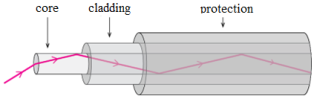
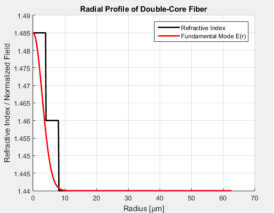
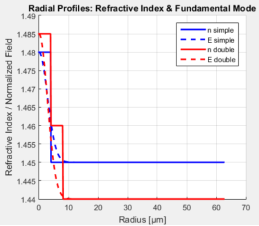
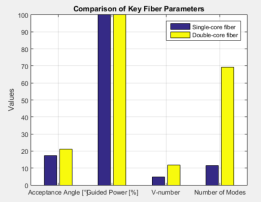
This work presents a detailed comparative study of single-core and concentric double-core optical fibers, highlighting their potential advantages for telecommunication applications. Using theoretical and numerical analysis, we examine key parameters including numerical aperture, acceptance angle, V-number, mode capacity, guided power fraction, and radial profiles of the fundamental mode. The double-core fiber exhibits a higher numerical aperture of 0.095 and an acceptance angle of 27.1°, compared to 0.078 and 19.6° for the single-core fiber, enabling more efficient light capture. The normalized frequency parameter (V-number) increases from 6.37 in the single-core fiber to 10.4 in the double-core design, resulting in a total of 54 guided modes versus 20 in the single-core fiber. Radial analysis shows that the fundamental mode is primarily confined within the inner core, with partial extension into the outer core. This distribution facilitates controlled modal coupling and flexible power management, which can be beneficial for multimode transmission or high-power applications. Although the guided power fraction remains 100% in both fiber types, the dual-core structure significantly reduces mode leakage and enhances confinement efficiency, highlighting its potential for robust signal transmission. The comparative results suggest that concentric double-core fibers provide a practical approach to increasing mode diversity and improving light confinement without introducing excessive complexity in fiber fabrication. The dual-core design also aligns with the requirements of advanced telecommunication strategies such as space-division multiplexing, where efficient distribution of multiple spatial channels is essential. Moreover, the dual-core architecture serves as a foundation for further optimization, including tailored core spacing, refractive index engineering, and controlled inter-core coupling, to maximize transmission capacity and signal stability. Overall, the findings demonstrate that double-core fibers offer clear advantages in terms of mode management, power confinement, and flexibility for high-capacity optical systems. These results provide valuable insights for future experimental studies and the development of next-generation multimode and high-performance fiber designs.
| Published in | American Journal of Information Science and Technology (Volume 9, Issue 4) |
| DOI | 10.11648/j.ajist.20250904.14 |
| Page(s) | 277-282 |
| Creative Commons |
This is an Open Access article, distributed under the terms of the Creative Commons Attribution 4.0 International License (http://creativecommons.org/licenses/by/4.0/), which permits unrestricted use, distribution and reproduction in any medium or format, provided the original work is properly cited. |
| Copyright |
Copyright © The Author(s), 2025. Published by Science Publishing Group |
Optical Fiber, Single-core Fiber, Double-core Fiber, Mode Confinement, V-number, Guided Power, Radial Profile
Parameter | Single-Core | Double-Core |
|---|---|---|
Core index | 1.48 | 1.485 / 1.460 |
Cladding index | 1.45 | 1.44 |
Core radius | 4 µm | 4 µm / 8 µm |
Wavelength | 1.55 µm | 1.55 µm |
Parameter | Simple core fiber | dual-core fiber |
|---|---|---|
Acceptance angle [°] | 19.6 | 27.1 |
Guided power [%] | 100 | 100 |
V-number | 6.37 | 10.4 |
Number of modes | 20 | 54 |
| Refractive Index |
| Numerical Aperture |
| [1] | Ghatak, A., Thyagarajan, K. Introduction to Fiber Optics. Cambridge University Press, 1998. |
| [2] | Keiser, G. Optical Fiber Communications, 5th Edition. McGraw-Hill Education, 2021. |
| [3] | Snyder, A. W., Love, J. D. Optical Waveguide Theory. Chapman and Hall, 1983. |
| [4] | Marcuse, D. Theory of Dielectric Optical Waveguides. Academic Press, 1991. |
| [5] | Kawanishi, S., Saruwatari, M. “Coupling Characteristics of Dual-Core Optical Fibers.” IEEE Journal of Quantum Electronics, 1982, 18(10), 1533–1541. |
| [6] | Fu, H. Y., Tam, H. Y., Shao, L. Y., Lu, C., Dong, X. “Dual-Core Photonic Crystal Fiber Sensors.” IEEE Sensors Journal, 2012, 12(5), 1208–1213. |
| [7] | Snyder, A. W. “Coupled-Mode Theory for Optical Waveguides.” Journal of the Optical Society of America, 1972, 62(11), 1267–1277. |
| [8] | MathWorks. Wave Optics and Fiber Design Using MATLAB. MathWorks Documentation, 2024. |
| [9] | COMSOL AB. Optical Waveguide Design Module User’s Guide. COMSOL Multiphysics, 2023. |
| [10] | Agrawal, G. P. Nonlinear Fiber Optics, 6th Edition. Academic Press, 2019. |
| [11] | Okamoto, K. Fundamentals of Optical Waveguides, 3rd Edition. Academic Press, 2021. |
| [12] | Koshiba, M. “Finite Element Approach to Optical Waveguide Analysis.” IEEE Transactions on Microwave Theory and Techniques, 1992, 40(9), 1819–1825. |
| [13] | Richardson, D. J., Fini, J. M., Nelson, L. E. “Space-Division Multiplexing in Optical Fibers.” Nature Photonics, 2013, 7(5), 354-362. |
| [14] | Monro, T. M., Belardi, W., Furusawa, K., Baggett, J. C., Broderick, N. G. R., Richardson, D. J. “Sensing with Microstructured Optical Fibers.” Optics Letters, 2001, 26(14), 1154-1156. |
| [15] | Yeh, P. Optical Waves in Layered Media, Wiley-Interscience, 2005. |
APA Style
Erica, R. H. N., Andriamanalina, A. N. (2025). Comparative Analysis of Single-Core and Double-Core Optical Fibers. American Journal of Information Science and Technology, 9(4), 277-282. https://doi.org/10.11648/j.ajist.20250904.14
ACS Style
Erica, R. H. N.; Andriamanalina, A. N. Comparative Analysis of Single-Core and Double-Core Optical Fibers. Am. J. Inf. Sci. Technol. 2025, 9(4), 277-282. doi: 10.11648/j.ajist.20250904.14
AMA Style
Erica RHN, Andriamanalina AN. Comparative Analysis of Single-Core and Double-Core Optical Fibers. Am J Inf Sci Technol. 2025;9(4):277-282. doi: 10.11648/j.ajist.20250904.14
@article{10.11648/j.ajist.20250904.14,
  author = {Randriana Heritiana Nambinina Erica and Ando Nirina Andriamanalina},
  title = {Comparative Analysis of Single-Core and Double-Core Optical Fibers},
  journal = {American Journal of Information Science and Technology},
  volume = {9},
  number = {4},
  pages = {277-282},
  doi = {10.11648/j.ajist.20250904.14},
  url = {https://doi.org/10.11648/j.ajist.20250904.14},
  eprint = {https://article.sciencepublishinggroup.com/pdf/10.11648.j.ajist.20250904.14},
  abstract = {This work presents a detailed comparative study of single-core and concentric double-core optical fibers, highlighting their potential advantages for telecommunication applications. Using theoretical and numerical analysis, we examine key parameters including numerical aperture, acceptance angle, V-number, mode capacity, guided power fraction, and radial profiles of the fundamental mode. The double-core fiber exhibits a higher numerical aperture of 0.095 and an acceptance angle of 27.1°, compared to 0.078 and 19.6° for the single-core fiber, enabling more efficient light capture. The normalized frequency parameter (V-number) increases from 6.37 in the single-core fiber to 10.4 in the double-core design, resulting in a total of 54 guided modes versus 20 in the single-core fiber. Radial analysis shows that the fundamental mode is primarily confined within the inner core, with partial extension into the outer core. This distribution facilitates controlled modal coupling and flexible power management, which can be beneficial for multimode transmission or high-power applications. Although the guided power fraction remains 100% in both fiber types, the dual-core structure significantly reduces mode leakage and enhances confinement efficiency, highlighting its potential for robust signal transmission. The comparative results suggest that concentric double-core fibers provide a practical approach to increasing mode diversity and improving light confinement without introducing excessive complexity in fiber fabrication. The dual-core design also aligns with the requirements of advanced telecommunication strategies such as space-division multiplexing, where efficient distribution of multiple spatial channels is essential. Moreover, the dual-core architecture serves as a foundation for further optimization, including tailored core spacing, refractive index engineering, and controlled inter-core coupling, to maximize transmission capacity and signal stability. Overall, the findings demonstrate that double-core fibers offer clear advantages in terms of mode management, power confinement, and flexibility for high-capacity optical systems. These results provide valuable insights for future experimental studies and the development of next-generation multimode and high-performance fiber designs.},
 year = {2025}
}
TY  - JOUR
T1  - Comparative Analysis of Single-Core and Double-Core Optical Fibers
AU  - Randriana Heritiana Nambinina Erica
AU  - Ando Nirina Andriamanalina
Y1  - 2025/12/09
PY  - 2025
N1  - https://doi.org/10.11648/j.ajist.20250904.14
DO  - 10.11648/j.ajist.20250904.14
T2  - American Journal of Information Science and Technology
JF  - American Journal of Information Science and Technology
JO  - American Journal of Information Science and Technology
SP  - 277
EP  - 282
PB  - Science Publishing Group
SN  - 2640-0588
UR  - https://doi.org/10.11648/j.ajist.20250904.14
AB  - This work presents a detailed comparative study of single-core and concentric double-core optical fibers, highlighting their potential advantages for telecommunication applications. Using theoretical and numerical analysis, we examine key parameters including numerical aperture, acceptance angle, V-number, mode capacity, guided power fraction, and radial profiles of the fundamental mode. The double-core fiber exhibits a higher numerical aperture of 0.095 and an acceptance angle of 27.1°, compared to 0.078 and 19.6° for the single-core fiber, enabling more efficient light capture. The normalized frequency parameter (V-number) increases from 6.37 in the single-core fiber to 10.4 in the double-core design, resulting in a total of 54 guided modes versus 20 in the single-core fiber. Radial analysis shows that the fundamental mode is primarily confined within the inner core, with partial extension into the outer core. This distribution facilitates controlled modal coupling and flexible power management, which can be beneficial for multimode transmission or high-power applications. Although the guided power fraction remains 100% in both fiber types, the dual-core structure significantly reduces mode leakage and enhances confinement efficiency, highlighting its potential for robust signal transmission. The comparative results suggest that concentric double-core fibers provide a practical approach to increasing mode diversity and improving light confinement without introducing excessive complexity in fiber fabrication. The dual-core design also aligns with the requirements of advanced telecommunication strategies such as space-division multiplexing, where efficient distribution of multiple spatial channels is essential. Moreover, the dual-core architecture serves as a foundation for further optimization, including tailored core spacing, refractive index engineering, and controlled inter-core coupling, to maximize transmission capacity and signal stability. Overall, the findings demonstrate that double-core fibers offer clear advantages in terms of mode management, power confinement, and flexibility for high-capacity optical systems. These results provide valuable insights for future experimental studies and the development of next-generation multimode and high-performance fiber designs.
VL  - 9
IS  - 4
ER  -
Telecommunications, Doctoral School of Engineering Science and Innovation Techniques (EDSTII), Antananarivo, Madagascar
Biography: Randriana Heritiana Nambinina Erica is a lecturer and researcher at the University of Antananarivo and a faculty member at the École Supérieure Polytechnique d’Antananarivo. He is also a doctoral candidate within the EDSTII doctoral school, specializing in telecommunications. His research focuses primarily on optical fiber technologies, including performance optimization, signal propagation, and applications in high-speed communication systems. He has contributed to several academic and applied research projects related to broadband network development and emerging communication infrastructures in Madagascar. His work reflects a strong commitment to advancing optical communication solutions adapted to local and regional technological needs. He actively participates in scientific activities through teaching, research supervision, and conference contributions.
Research Fields: Telecommunication, transmission, optical fiber, optical communication, Signal Processing

Telecommunications, Doctoral School of Engineering Science and Innovation Techniques (EDSTII), Antananarivo, Madagascar




 Share This Article
 Twitter
 Linked In
 Facebook
 Copy
Copy Download